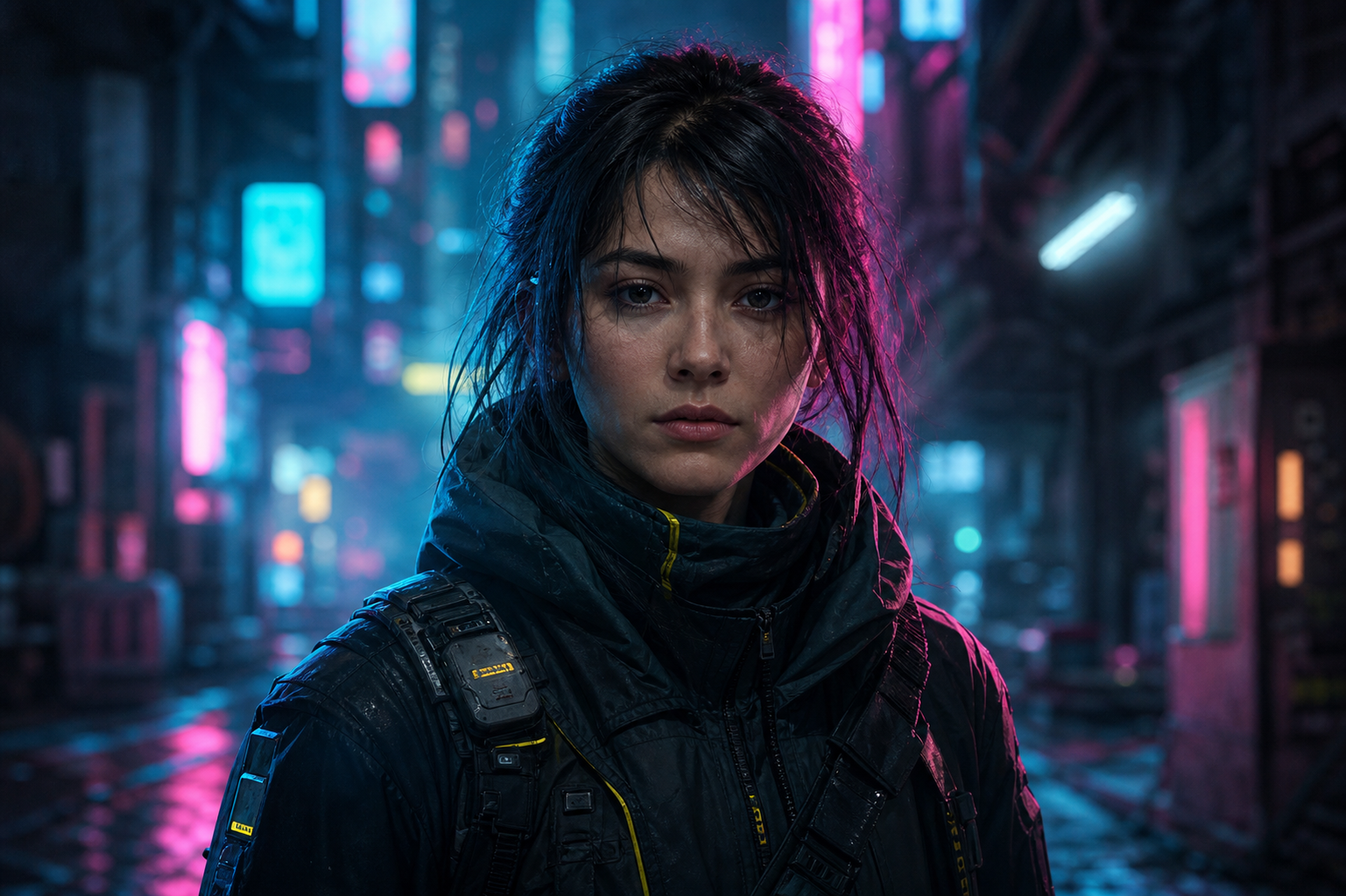
NEON
NOIR.
High-tech, low-life. Every glowing surface in this city is a billboard, a HUD, a surveillance signal — beauty that comes with an owner attached.
// LOG_01 — THE QUESTION
Who owns the lights
you find beautiful?
That neon sign over the rain-slicked street isn't civic infrastructure. It's an ad. It was always an ad.
Cyberpunk is the only style here with a politics built into its palette: dazzling technology, owned by someone who is not you, turned against the people underneath it.
The beauty is deliberate. The discomfort is the point.
// LOG_02 — TRANSMISSION HISTORY
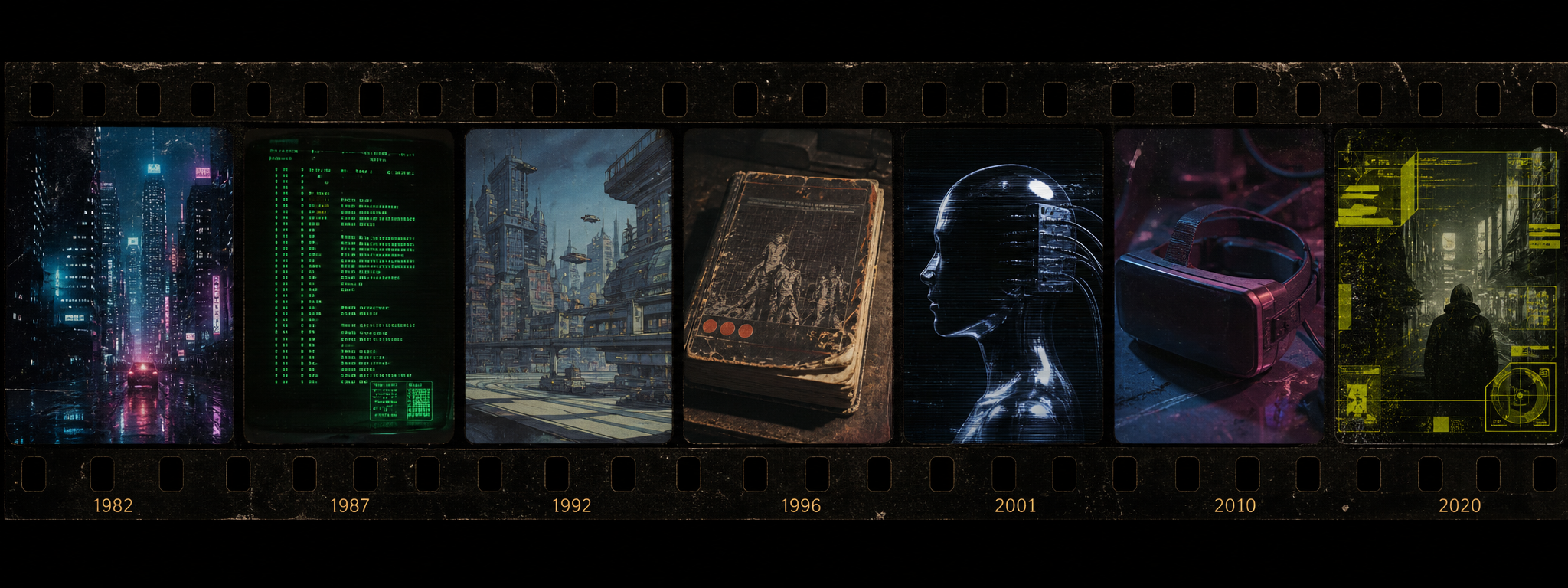
Fifty Years of Warning Signs.
Cyberpunk didn't arrive fully formed. It accumulated, decade by decade, every time someone noticed who really owned the future.
Philip K. Dick plants the seed
"Do Androids Dream of Electric Sheep?" is published. Dick's founding anxiety — technology indistinguishable from the human it serves — becomes the genre's permanent undercurrent. No neon yet. Just the rot underneath shiny machines.
Blade Runner builds the city
Ridley Scott and Syd Mead fuse Tokyo's Shinjuku signage with noir cinematography: perpetual rain, perpetual night, a megacorp skyline. The film bombs at the box office. It will define the visual grammar of a genre that doesn't have a name yet.
William Gibson names it: Neuromancer
Gibson — who wrote the novel on a manual typewriter, having never touched a computer — coins "cyberspace" almost by accident. The Sprawl becomes the template city: data as a place, corporations as governments, hustle as survival.
Akira brings it home to Japan
Katsuhiro Otomo's Neo-Tokyo — informed by Japan's own post-war reconstruction trauma — gives cyberpunk a second visual language: biker gangs, elevated highways, military-corporate collusion.
Ghost in the Shell asks what's left
Masamune Shirow's manga pushes the genre's core question further: if body and memory can be replaced with chrome, what's actually left of "you"? The full-body cyborg becomes one of the genre's most iconic images.
Cyberpunk 2020 codifies the kit
Mike Pondsmith's tabletop RPG turns mood into rule system: street samurai, netrunners, chrome traded like car parts. The aesthetic becomes something other creators can build with directly.
Deus Ex makes it playable
HUD overlays, cybernetic vision modes, conspiratorial megacorps — you no longer just watch cyberpunk's politics, you walk through them and choose a side.
Cyberpunk 2077 — apex and cautionary tale
Night City becomes the genre's most detailed realization yet. The disastrous, bug-ridden launch becomes its own accidental parable: a dazzling promise that shipped broken, sold anyway, apologized later.
The look outlives the politics
Neon-on-black and glitch type are now a default skin for crypto platforms and streetwear — frequently stripped of the genre's anti-corporate anger and sold by corporations. Cyberpunk keeps proving its own thesis.
MNCR
// LOG_03 — THE PEOPLE
A typewriter.
No computer in sight.
William Gibson wrote "Neuromancer" on a manual typewriter. He had never used a computer when he coined the word "cyberspace." It just sounded like it meant something.
That's the joke buried at the center of the entire genre: its most famous technologist never touched the technology. He was extrapolating from arcade cabinets and Walkmans, watching Wall Street wealth and street-level decay sit a few blocks apart.
Philip K. Dick wrote from genuine poverty and paranoia. Ridley Scott and Syd Mead built a 2019 Los Angeles as a rebuke to the gleaming "world of tomorrow" Hollywood had been selling since the 1950s. Katsuhiro Otomo and Masamune Shirow wrote from a Japan that rebuilt itself into a superpower atomic-bomb-fast — and were deeply skeptical of the cost.
None of them were celebrating technology. They were diagnosing what happens to ordinary people when extraordinary technology gets owned by someone else. The neon is gorgeous specifically because the world underneath it is not.
"The sky above the port
was the color of television,
tuned to a dead channel."
// LOG_04 — THE DESIGN DNA
Four Signals.
All Hostile.
Each visual element in cyberpunk is doing surveillance work even when it looks like decoration. Here's what you're actually looking at.
MAXIMUM CONTRAST
Shinjuku signage, photographed for Blade Runner (1982)
Electric yellow and cyan detonating against near-total black. No mid-tones, no rest for the eye. Advertising has colonized the night itself — in this city even darkness is owned and monetized.
ANGLED GEOMETRY / HUD FRAMES
Fighter-jet cockpit displays, targeting reticles
Clipped corners, diagonal slices, and bracket frames lifted straight from heads-up displays. You are always being tracked, scanned, or targeted by something — the frame turns you into observer and target at once.
GLITCH & SCANLINES
Analog CRT signal failure, RGB channel misalignment
RGB-split text and rolling scanlines that look one bad connection from total failure. Glitch is proof the system — corporate, digital, social — is held together by duct tape and is always one fault from collapse.
RAIN & REFLECTION
Blade Runner's wet streets, film noir mood lighting
Wet pavement doubling every neon sign, turning the ground into a fractured second sky. Even the puddles are commercialized — every reflection is more advertising.
// LOG_05 — STILL BROADCASTING
The Canonical
References
The dossier. Study it before you build with this style.
Philip K. Dick's founding anxiety — technology indistinguishable from the human it threatens to replace.
Syd Mead's production design fuses Shinjuku neon with noir shadow. Bombed at release. Defined the genre's eyes anyway.
Gibson coins "cyberspace," gives the genre its name and The Sprawl as its template city.
Otomo's Neo-Tokyo brings the genre's anxieties home — military-corporate collusion, disposable bodies and cities.
The human-machine merger pushed to its logical, unsettling conclusion. Directly inspired The Matrix.
Mike Pondsmith codifies mood into a buildable rule system — street samurai, netrunners, chrome.
Night City as the most detailed realization yet — and its own accidental cautionary tale.
// WHERE IT WORKS
// LOG_06 — THE VERDICT
The aesthetic that warned you
about megacorps is now
licensed by megacorps.
The neon never stopped being a billboard. It just changed clients. When you design in cyberpunk, you're not just picking yellow and cyan — you're invoking a thesis about who owns the future. Use it knowing the irony comes free.