Paris · 1925
GOLD
BEFORE
THE CRASH.
A continent that just survived the deadliest war in its history threw the most beautiful party imaginable — and built skyscrapers shaped like fireworks while they were at it. The party had ten years left. Most of the people building it didn't know that yet.
Scene 01 — The Question
How does a style built
entirely on confidence
survive the one thing
confidence cannot survive?
Art Deco was named at a party in 1925. Its two most famous buildings were finished after the party ended — the stock market crashed in 1929, and the Chrysler and Empire State towers opened in 1930 and 1931, monuments to a confidence that had already died.
Then a world war nearly finished the job. Materials rationed, craftsmen conscripted, the entire style dismissed within twenty years as dated kitsch — buildings stripped of their own ornament because nobody wanted yesterday's glamour.
And yet it came back. Twice. Because a historian bothered to name it, and a preservationist refused to let the bulldozers win. That resilience — not the gold leaf — is the real subject of this page.
Scene 02 — How We Got Here
A Decade
That Outran Itself.
Egyptian gold, a Paris exposition, a skyscraper race, a crash, a war, and two rescues. Follow the line.
Tutankhamun's tomb cracks open
Howard Carter's five-year, nearly bankrupt search finds a sealed doorway in the Valley of the Kings. Inside: 3,245 years of undisturbed gold. Newspapers run daily updates. Fashion houses launch "Egyptian" collections within months. Lotus columns, scarabs, stepped pyramids, and gold-on-black color schemes flood directly into the decorative arts on a media cycle, in real time.
Paris names the style — and the party
The Exposition Internationale des Arts Décoratifs et Industriels Modernes opens on the Champ de Mars. No historical revivals allowed. Lalique's glass fountain, Delaunay's textile pavilion, geometric ornament everywhere. The fair crystallizes a decade of scattered influences into one exportable language — and decades later gives the whole movement its name: Art Déco.
The Jazz Age roars
Flappers, speakeasies, a stock market that seems to climb forever. Cocktail bars get mirrored sunburst panels. Theater marquees blaze with neon chevrons. Money is loose and the assumption — wrong, but sincerely held — is that the good times are structural, not temporary.
Black Tuesday. The music stops.
October 29. The stock market collapses. The wealth that funded Deco's golden decade evaporates in weeks. The party that built the style is over before the style's two most famous monuments are even finished.
Chrysler and Empire State race the sky
William Van Alen assembles the Chrysler Building's spire in secret inside the fire shaft and hoists it into place in 90 minutes — beating his own former business partner to "world's tallest." The Empire State Building tops it within a year, built in 410 days. Both monuments to optimism are completed after the optimism died. The Empire State sits half-empty for years, nicknamed the "Empty State Building."
Streamline Moderne sobers the look
Gilded ornament reads as tone-deaf in a breadline economy. A sleeker cousin emerges — smooth curves, speed-lines, porthole windows, borrowed from aerodynamics. Miami Beach quietly builds hundreds of small Streamline hotels, laying groundwork no one yet recognizes as historic.
World War II nearly erases it
Materials are rationed, craftsmen are conscripted, construction halts. Postwar Modernism arrives — glass boxes, zero ornament, explicitly not nostalgic for prewar glamour. Within twenty years "the most modern style in the world" is dismissed as dated kitsch, and buildings get stripped of their own ornament.
Bevis Hillier names the past
A British historian publishes the book that popularizes the retrospective term "Art Deco," turning scattered, dismissed decoration into a coherent, collectible, studyable movement. Naming it is what makes reviving it possible.
Barbara Capitman saves Miami Beach
Developers want to bulldoze the aging Streamline hotels for high-rises. Capitman's preservation fight wins the Miami Beach Architectural District a spot on the National Register — the first 20th-century district ever listed. Without her, South Beach's entire identity gets demolished.
Gatsby, again and again
Miami Vice. The 1974 and 2013 Gatsby films. Every era that rediscovers Art Deco finds the same trick still works: maximalist glamour, built from disciplined geometry, reads as luxury to anyone, in any decade.
Scene 03 — The People
A boy king's gold.
A secret race to the sky.
November 1922, Valley of the Kings. Howard Carter has spent five years and someone else's fortune looking for a tomb most experts assumed was already found and looted. He has no idea he is about to hand an entire design movement its color palette.
Inside: gold on black, lotus columns, the eye of Horus, three thousand years sealed in the dark. Within months, fashion houses launch "Egyptian" collections. The world wants this look before it even has a name for the style it is about to become part of.
Three years later, two architects are racing each other to build the tallest building on Earth — and one of them used to be the other's business partner. William Van Alen has his Chrysler Building spire built in secret pieces inside the fire shaft, hoisted into position in under ninety minutes, specifically so H. Craig Severance can't see it coming and adjust his own tower in time.
Walter Chrysler bankrolls the whole thing personally because he wants a skyscraper that visibly *is* a car company — hubcap motifs, radiator-cap gargoyles, chrome-nickel steel stamped by his own factories. He wins. For less than a year. The Empire State Building tops it in 1931, built in 410 days flat.
Both towers are monuments to a confidence that had already died by the time the ribbon was cut. The crash came first. The buildings finished anyway — because you don't stop pouring concrete halfway up a skyscraper just because the economy that financed it collapsed underneath you.
Fifty years later, a different kind of fight: Barbara Capitman standing in front of bulldozers in Miami Beach, arguing that a strip of small, faded, unfashionable hotels deserved federal protection. Developers wanted glass towers. She won the first 20th-century historic district in America. The style that died twice — once in the Depression, once in the war — got a third act because one woman refused to let it get torn down.
"Two towers, racing to be
the tallest monuments
to a confidence already dead."
Scene 04 — The Design DNA
Four Signals.
All Engineered.
Nothing in Deco looks accidental. Every line below was drawn with a ruler on purpose.
RADICAL SYMMETRY
Beaux-Arts training, sharpened by the 1925 Paris exposition
Mirror-perfect, centered compositions — a clear vertical axis everything else balances around. After a war that felt chaotic and senseless, symmetry reads as control, and control reads as competence. It is order as reassurance, dressed up as luxury.
SUNBURST & ZIGGURAT
Egyptian motifs (post-1922) and New York's 1916 setback zoning law
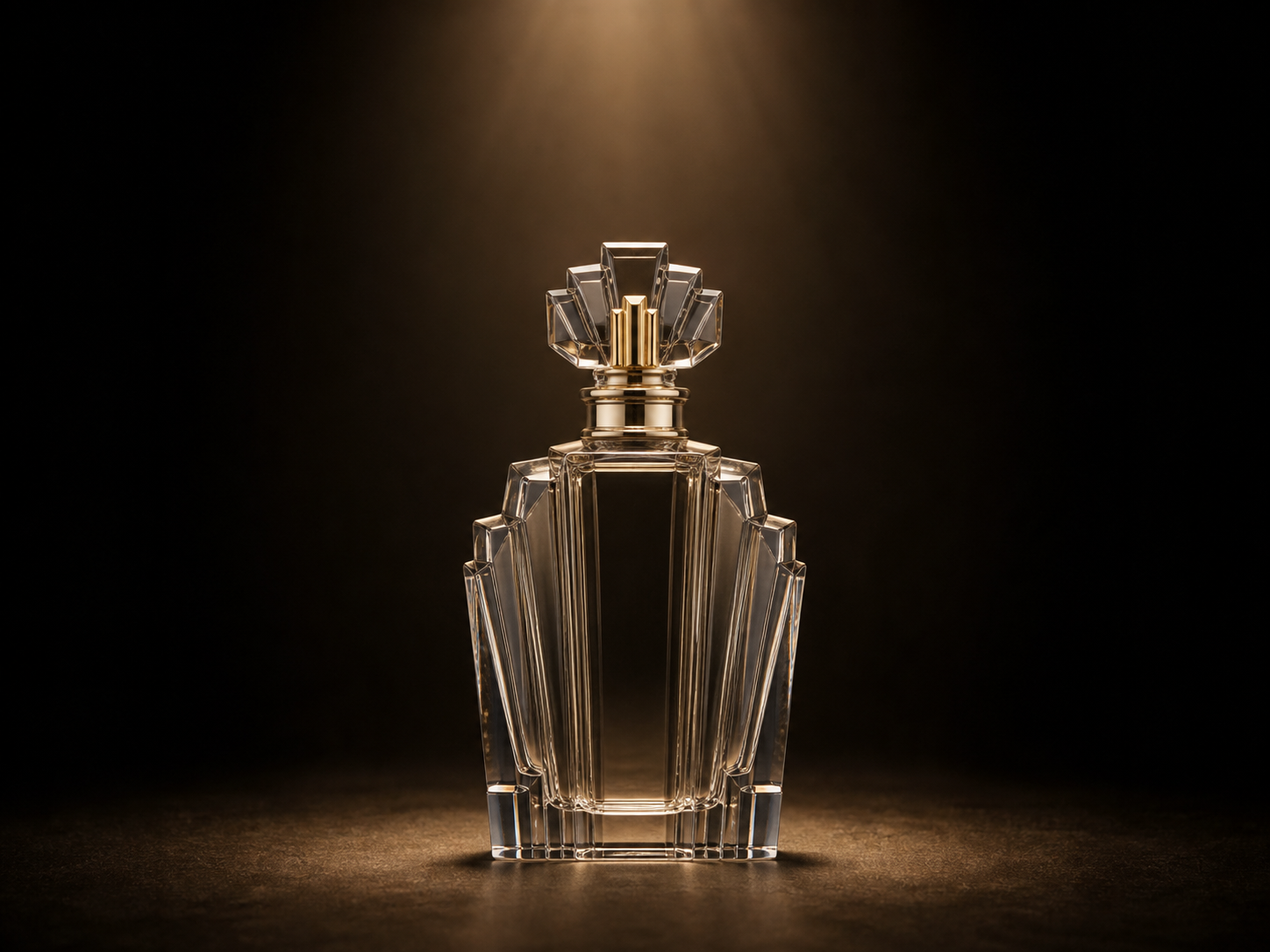
Radiating fan shapes and stair-stepped silhouettes, standing in for the irregularity of nature. The ziggurat step turns a legal zoning constraint — buildings forced to set back from the street as they rise — into the era's most recognizable shape: ambition, literally stacked.
GOLD ON DARK
Tomb-gold palettes filtered through Jazz Age nightlife
Warm metallics — gold, brass, bronze, chrome — set hard against black lacquer, deep emerald, midnight navy. Dark grounds make metal read as light itself. It is a palette built for electric light, not daylight: cocktail bars, theater lobbies, ocean-liner staterooms.
MARQUEE LETTERING
Theater marquees and ocean-liner signage, sharpened by Cubist letterform experiments
Tall, evenly spaced capitals built to be read across a lobby, not a printed page. Letter-spacing this wide says: I am not in a hurry, and neither should you be. It performs leisure and permanence in the same breath.
Scene 05 — The Archive
The Canonical
References
The objects, buildings, and rescues that define the era. Study them.
The single discovery that injected Egyptian gold-and-geometry motifs directly into the movement's bloodstream.
The world's fair that gave the entire movement its name — and crystallized a decade of influences into one style.
Proof that mass-producible pressed glass could carry genuine luxury — industry and opulence, reconciled.
Van Alen's secretly-assembled spire, briefly the tallest building on Earth — a car company's logo, built at city scale.
The skyscraper-race winner, built in 410 days, finished after the crash it was meant to celebrate.
Capitman's rescue of Streamline Moderne — the first 20th-century district on the National Register.
Two cultural moments, decades apart, that re-popularized Jazz Age opulence for new generations.
Where it works
Scene 06 — The Verdict
The crash couldn't kill it.
The war couldn't kill it.
Someone just had to refuse to let it die.
Art Deco was built on a confidence that broke in 1929 and nearly got erased by 1945. It came back anyway — not because the gold leaf was irresistible, but because a historian gave it a name in 1966 and a preservationist stood between it and a bulldozer in 1976. That is the real lesson under the sunbursts: glamour fades, but it can always be rescued by someone who decides it is worth the fight.